The Furness Method, also commonly referred to as the Fratar Method or iterative proportional fitting (IPF), is one of the most widely used matrix balancing techniques in transportation planning. It is commonly applied when an initial estimate of a traffic matrix exists, but the row and column totals must be adjusted to match observed traffic volumes.
Although the method is best known for trip distribution and origin-destination (OD) matrix balancing, it can also be applied to many traffic engineering problems, including turning movement estimation, intersection traffic balancing, and reconciling incomplete traffic count data.
This article explains how the Furness Method works, provides a simple worked example, discusses its advantages and limitations, and highlights practical applications in transportation engineering.
What is the Furness Method?
The Furness Method is an iterative balancing algorithm that adjusts the values in a matrix so that the totals of every row and every column match known control totals.
Instead of changing traffic patterns arbitrarily, the algorithm preserves the relative distribution of trips as much as possible while ensuring that the final matrix satisfies the observed constraints.
In simple terms:
Start with an estimated traffic matrix → repeatedly scale rows and columns → stop when the totals match the observed traffic volumes.
Because each iteration brings the matrix closer to the desired totals, the method usually converges rapidly for well-behaved transportation problems.
Why is the Furness Method Needed?
Transportation engineers frequently encounter incomplete traffic data.
Examples include:
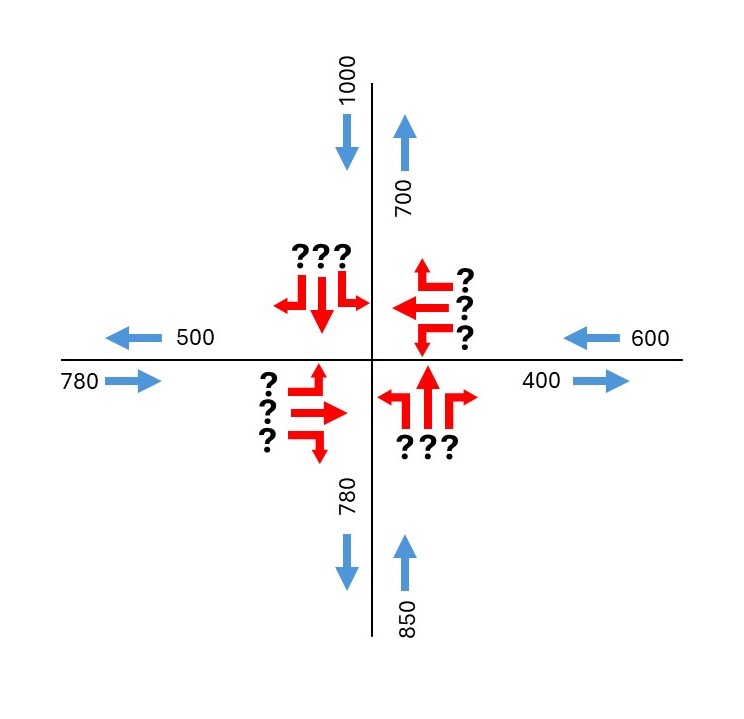
- Directional roadway volumes are known, but turning movements are unavailable.
- An origin-destination matrix is several years old, but updated traffic counts are available.
- Some turning movements have been counted while others are missing.
- Traffic assignments do not balance with observed roadway volumes.
Simply applying fixed turning percentages or scaling every movement by the same factor often produces inconsistent results because the estimated traffic entering and leaving an intersection no longer matches the observed counts.
The Furness Method addresses this problem by producing a matrix that satisfies all available traffic constraints while remaining as close as possible to the original estimate.
How the Furness Method Works
The process consists of alternating between adjusting row totals and column totals.
Suppose an initial turning movement matrix is available.
Step 1: Scale each row so that its total equals the known entering traffic volume.
Step 2: Scale each column so that its total equals the known exiting traffic volume.
After adjusting the columns, the row totals will no longer match perfectly.
The algorithm therefore repeats these two steps until both the row and column totals converge to the desired values within an acceptable tolerance.
This repeated balancing process is why the method is often called an iterative balancing algorithm.
Worked Example of Furness / Fratar Balancing
Suppose a three-leg intersection has the following estimated turning movements.
| From / To | North | East | South | Total |
|---|---|---|---|---|
| North | 50 | 150 | 100 | 300 |
| East | 80 | 40 | 80 | 200 |
| South | 120 | 30 | 50 | 200 |
Assume field counts indicate the actual entering traffic should be:
- North = 350
- East = 180
- South = 220
while the exiting traffic should total:
- North = 270
- East = 260
- South = 220
The initial matrix does not satisfy these totals.
The Furness Method first scales each row to match the known entering volumes.
It then scales each column to match the exiting volumes.
After several iterations, the adjusted matrix converges so that:
- Every row total matches the observed entering traffic.
- Every column total matches the observed exiting traffic.
- The relative turning pattern remains similar to the original estimate.
The result is a balanced traffic matrix that is consistent with the available data.
Mathematical Concept
The Furness Method applies proportional adjustment factors during each iteration.
For row balancing:
Adjusted Cell = Existing Cell × Row Adjustment Factor
where:
Row Adjustment Factor = Desired Row Total ÷ Current Row Total
The same process is then repeated for every column using the corresponding column adjustment factor.
These alternating scaling operations continue until the difference between the calculated totals and the target totals is sufficiently small.
Advantages
The Furness Method has remained popular for decades because it is:
- Simple to implement
- Computationally efficient
- Stable for most transportation applications
- Easy to understand and verify
- Able to preserve existing traffic patterns
- Suitable for both small intersections and large OD matrices
Modern computers can balance thousands of matrix cells in only a fraction of a second.
Limitations of Furness
Like any estimation technique, the Furness Method has limitations.
It assumes the initial traffic pattern is reasonably representative of actual travel behaviour. If the starting matrix is unrealistic, the balanced result may also be unrealistic.
The method also cannot create new travel patterns that are not reflected in the original estimate. It simply redistributes existing traffic while satisfying the specified constraints.
For this reason, engineering judgment remains essential when selecting the initial matrix and interpreting the final results.
Applications in Traffic Engineering
The Furness Method is widely used in transportation planning and traffic engineering, including:
- Origin-Destination (OD) matrix balancing
- Turning Movement Count (TMC) estimation
- Travel demand model calibration
- Screenline balancing
- Intersection traffic balancing
- Updating historical traffic matrices
- Reconciling incomplete traffic count data
Because of its flexibility, the method is often one of the first matrix balancing techniques taught in transportation planning and travel demand modelling.
Furness Method vs. Fratar Method
The terms Furness Method and Fratar Method are frequently used interchangeably.
Strictly speaking, the original Fratar growth model incorporated trip growth factors, while the Furness Method refers to the iterative balancing procedure itself. However, in modern transportation planning practice, the combined term “Furness (Fratar) Method” is commonly used to describe iterative proportional matrix balancing.
Using the Furness Method for Turning Movement Estimation
One practical application of the Furness Method is estimating turning movement counts at intersections when complete field counts are unavailable.
Starting with directional roadway volumes and an initial set of turning movement assumptions, the method generates an internally balanced set of turning movements that satisfies the observed approach and downstream traffic volumes. Engineers can then refine individual movements based on local knowledge, lane configurations, access locations, or observed traffic behaviour while maintaining overall traffic balance.
This approach is particularly useful for preliminary traffic impact assessments, conceptual design studies, and planning-level operational analyses.
If you’re looking for a practical implementation of this workflow, try the Arterials.co AADT to Turning Movement Estimator, which uses the Furness (Fratar) balancing method to generate an initial balanced turning movement matrix from AADT or directional link volumes before allowing interactive refinement.
Conclusion
The Furness (Fratar) Method remains one of the most useful and widely applied matrix balancing techniques in transportation engineering. Its combination of simplicity, computational efficiency, and ability to preserve existing traffic patterns has made it a standard tool for balancing origin-destination matrices, estimating turning movements, and reconciling incomplete traffic data.
Whether you’re calibrating a travel demand model or estimating turning movements for a planning-level traffic study, understanding how the Furness Method works provides a solid foundation for producing internally consistent traffic analyses.