Categories, Study Levels, and Memo vs Report Requirements Across Jurisdictions
Traffic Impact Assessments (TIAs) are a core component of development review, but requirements vary significantly by jurisdiction. While thresholds like “100 peak hour trips” are commonly cited, agencies such as TxDOT, FDOT, municipalities in New York, and the City of Toronto apply different criteria based on scale, context, and network sensitivity.
This guide compares how TIAs are triggered, categorized, and documented across major jurisdictions, and clarifies when a memo is sufficient versus when a full report is required.
When is a TIA Required?
Common Principle Across Jurisdictions
A TIA is required when a development is expected to materially impact the transportation network. However, how that impact is defined varies.
Texas (TxDOT) TIA Requirements
- Typical trigger: ≥100 peak hour trips
- Additional triggers:
- Access to state highways
- Safety or operational concerns
- Access management deviations
TxDOT applies a trip generation based threshold + engineering judgment
Florida (FDOT)
- No single universal trip threshold
- TIA requirement tied to:
- State roadway impacts
- Access permitting
- Development of Regional Impact (DRI) / large-scale developments
FDOT focuses more on capacity and safety impacts to the Strategic Intermodal System (SIS) rather than a strict numeric trigger
New York (NYC / NYSDOT context)
- No fixed trip threshold in many cases
- TIA required when:
- Rezoning or discretionary approvals are triggered
- Environmental review (SEQRA / CEQR) is required
- Significant intersection impacts are anticipated
New York relies heavily on environmental review frameworks, not just trip generation
Toronto (City of Toronto / GTA)
- TIA required as part of development application review
- Triggers include:
- Site plan approval / rezoning
- Proximity to congested corridors or transit nodes
- Often required even for moderate developments in dense areas
Toronto uses a context-sensitive approach, especially in transit-oriented and urban environments.
Key Insight Across all jurisdictions:
- Trip thresholds are guidelines, not rules
- Location matters as much as size
- Urban areas tend to require TIAs at lower thresholds
Need a ready-to-use Traffic Impact Assessment template? Download the Arterials TIA Template
TIA Categories and Levels of Analysis
While naming conventions differ, most jurisdictions follow a tiered approach similar to TxDOT.
Level 1: Screening / Scoping Study (Traffic Memo)
Typical Conditions:
- Small developments
- Minimal expected impact
- Early-stage review
Jurisdictional Equivalent:
- TxDOT: Engineering Study
- FDOT: Traffic Operational Analysis (limited scope)
- Toronto: Scoped Transportation Brief
- NYC: Screening-level CEQR analysis
Scope:
- Trip generation
- Basic trip assignment
- Turning movement estimates
- Access review
Purpose: Determine if a full TIA is required
Level 2: Intermediate Study (Focused TIA / Technical Memo)
Typical Conditions:
- Moderate trip generation
- Localized impacts
- Few affected intersections
Scope:
- Study area: ~0.5 to 1 mile
- Capacity analysis (HCM-based)
- Existing + future background + build scenarios
- Limited mitigation recommendations
Level 3: Full TIA (Comprehensive Study)
Typical Conditions:
- Large developments
- Network-level impacts
- Multi-phase buildout
Scope:
- Trip generation (ITE-based)
- Distribution and assignment
- Multi-year horizon analysis
- LOS, delay, queue analysis
- Corridor and intersection evaluation
- Mitigation and improvement strategies
Jurisdictional Notes:
- Required by TxDOT for high trip generators
- Required in NYC under CEQR for significant impacts
- Standard for large developments in Toronto and FDOT corridors
Read: What to do if the ITE trip generation manual has limited or unreliable data.
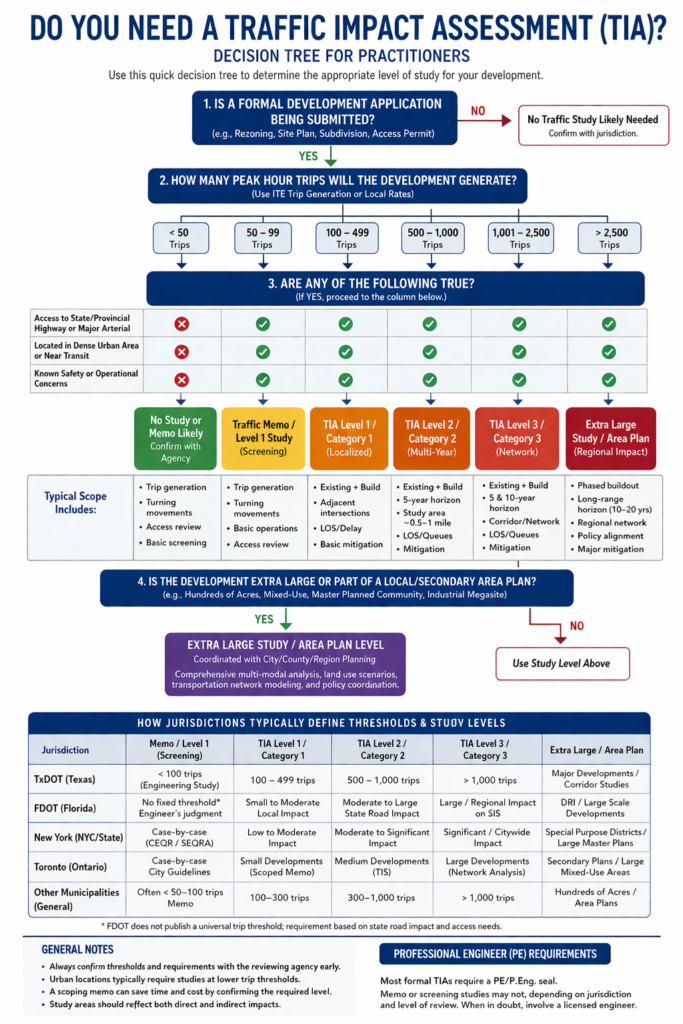
Traffic Memo vs Full TIA Report
Traffic Memo (or Transportation Brief)
Appropriate Use Cases
- Low-impact developments
- Early-stage scoping
- Minor access or site plan changes
Typical Contents
- Site description
- Trip generation (ITE or local rates)
- Basic trip distribution
- Turning movement estimates
- Access review
What a Traffic Memo Should NOT Include
- Full network-wide LOS analysis
- Extensive modeling (Synchro/VISSIM) unless specifically requested
- Multi-horizon forecasts (5–10 years)
- Detailed mitigation design
In jurisdictions like Toronto, overloading a memo with unnecessary analysis can actually slow approvals.
Full TIA Report
Required When
- Multiple intersections are impacted
- Roadway capacity deficiencies are expected
- Agency review requires formal mitigation
Core Components
- Existing conditions data collection
- Background growth and committed developments
- Trip generation, distribution, assignment
- Capacity analysis (HCM / Synchro)
- Queue and storage analysis
- Safety and access evaluation
- Mitigation recommendations
Key Difference between TIA Memo and Report
| Aspect | Memo | Full TIA |
|---|---|---|
| Purpose | Screening | Full evaluation |
| Scope | Site-level | Network-level |
| Modeling | Minimal | Comprehensive |
| Approval Role | Informal / preliminary | Formal review document |
Professional Engineer (PE) Requirements for Traffic Impact Studies
While PE requirements for TIAs vary accross states, provinces, counties, towns, regions, cities, and other approving bodies, some example requirements are provided as follows:
| Jurisdiction | PE Requirement | Notes |
|---|---|---|
| TxDOT (Texas) | Required | TIAs must be prepared under a licensed P.E.; reports must be signed, sealed, and dated for submission, especially for state highway access |
| FDOT (Florida) | Required (for permits) | PE certification required for analyses tied to access permits and state roadway impacts; must conform to FDOT standards |
| New York (NYC / NYSDOT context) | Generally required | No single statewide rule; studies tied to environmental review (CEQR/SEQRA) or permitting typically require professional certification depending on agency |
| Toronto / Ontario (e.g., City of Toronto) | Typically required | Transportation Impact Studies are usually prepared by qualified professionals; a P.Eng. seal is commonly expected for formal development applications, though not always explicitly stated in guidelines |
| California (many cities/counties) | Varies | Larger jurisdictions (e.g., state or major cities) typically require PE; smaller cities may accept traffic memos without seal for low-impact developments |
| Washington State (local jurisdictions) | Varies | State-level work requires PE; some municipalities allow unsealed traffic memos for small developments or screening studies |
| Arizona (municipal level) | Often required, but flexible | PE usually required for full TIAs; informal memos or preliminary studies may not require seal depending on city |
| Small / Rural Municipalities (North America, general case) | Sometimes not required | For low-impact developments, jurisdictions may accept consultant-prepared memos without PE seal, especially for internal review or early-stage approvals |
General Rule Across Jurisdictions
| Study Type | PE Requirement |
|---|---|
| Screening Memo | May not require seal (internal use) |
| Submission Memo | Often requires PE |
| Full TIA | Almost always requires PE |
| Studies impacting public roads | PE mandatory |
If the study influences:
- Roadway design
- Access permits
- Signal modifications
A licensed engineer is required in virtually all jurisdictions.
Practical Insights for Practitioners
- Start with a scoping discussion
– Many agencies (especially in Texas and Florida) expect this - Don’t over-scope early
– A memo can often satisfy initial requirements - Urban areas require more analysis with fewer trips
– Toronto and NYC are prime examples - TIA thresholds are not universal
– Always confirm with local guidelines
Key Takeaways
- TIA requirements vary, but all jurisdictions focus on network impact, not just trip counts
- Three general study levels exist across agencies:
- Screening Memo
- Intermediate Study
- Full TIA
- The difference between a memo and a full report is depth, scale, and purpose
- PE involvement is required for most formal submissions
- Early scoping can significantly reduce time, cost, and rework
A Traffic Impact Assessment is not a one-size-fits-all requirement. Understanding how different jurisdictions apply thresholds, categorize studies, and define deliverables is critical for efficient project delivery.
Selecting the appropriate level of analysis, whether a memo or a full TIA, ensures that studies are proportionate, defensible, and aligned with agency expectations.
Frequently Asked Questions (FAQs)
What is the typical threshold for requiring a TIA?
In many jurisdictions, a TIA is typically required when a development generates around 100 peak hour trips. However, this varies by agency. Some jurisdictions (e.g., urban areas like Toronto or New York) may require traffic impact studies at lower thresholds based on context, while others (e.g., TxDOT or FDOT) also consider access and safety impacts in addition to trip generation.
Can a project be approved without a TIA?
Yes. Smaller developments with minimal traffic impact may only require a traffic memo or engineering study, or in some cases no formal study at all. This is typically confirmed through a scoping process with the reviewing agency.
What is the difference between a traffic memo and a full TIA?
A traffic memo is a screening-level document that includes basic trip generation and access review. A full TIA is a comprehensive analysis that evaluates network performance, including Level of Service (LOS), delays, queues, and mitigation measures.
Who determines the scope of a TIA?
The scope is usually determined by the reviewing agency (state DOT, city, or municipality) in coordination with the project team. Many jurisdictions require a scoping meeting or submission before the study begins.
Do all TIAs require a Professional Engineer (PE) seal?
Not always.
- Internal or preliminary memos may not require a seal
- Most submitted studies, especially full TIAs, require a licensed Professional Engineer (P.E. or P.Eng.)
- Any study affecting public roadway design or permitting will almost always require certification
What analysis methods are typically used in a TIA?
Common methods include:
- Trip generation (based on ITE rates)
- Trip distribution and assignment
- Capacity analysis using Highway Capacity Manual (HCM) methodologies
- Software tools such as Synchro or similar platforms
How large is a typical TIA study area?
The study area depends on project size:
- Small developments: immediate site access and nearby intersections
- Medium developments: up to ~1 mile
- Large developments: corridor-level or network-wide analysis
What happens if a TIA identifies traffic issues?
If deficiencies are identified, the study will recommend mitigation measures, such as:
- Turn lanes
- Signal timing adjustments
- Signalization
- Roadway widening or access modifications
These improvements may be required as conditions of development approval.
Are TIA requirements the same in every city or state?
No. Requirements vary widely between jurisdictions. For example:
- Texas emphasizes trip thresholds and access to state highways
- Florida focuses on state roadway and safety impacts
- New York and Toronto rely more on planning approvals and contextual impacts
When should a TIA be initiated during a project?
A TIA should be initiated early in the planning or site design stage, ideally before finalizing access points or site layout. Early analysis helps avoid redesign and approval delays.