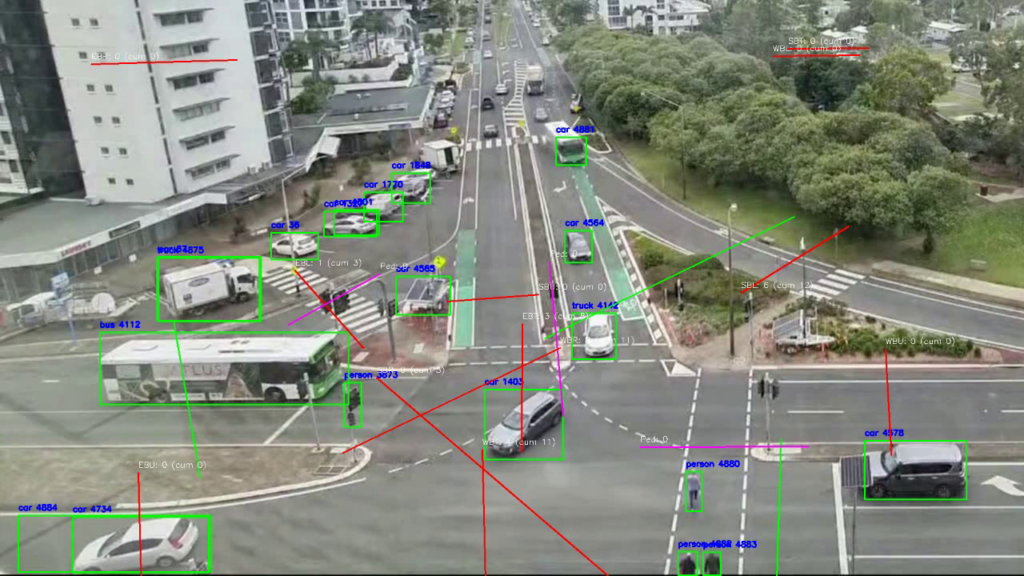
In transportation planning and traffic impact studies, a common problem is the lack of turning movement counts (TMCs). However, intersection capacity analysis still requires left, through, and right turning volumes.
In practice, when turning movement counts are not available, engineers often need a structured way to estimate them from AADT or link volumes.
A simple implementation of this workflow is available in the AADT to Turning Movement Estimator by Arterials, which converts link volumes into planning-level TMCs using K-factors, PHF, and user-defined turn distributions.
This approach allows engineers to proceed with early-stage intersection analysis even when field-collected turning movement data is missing.
When field TMC data is not available, engineers often rely on AADT (Annual Average Daily Traffic) or link volumes to estimate turning movements.
This article explains how to estimate TMCs from AADT or link volumes in practical engineering workflows.
When Turning Movement Counts Are Not Available
TMCs are typically collected through manual counts, tube counts, or video-based traffic surveys. However, they are often missing in practice due to:
- low-budget or preliminary traffic studies
- rural or low-volume intersections
- outdated traffic count data
- short project timelines
- conceptual or feasibility-stage design
In these cases, engineers must estimate turning movements using available traffic volume data.
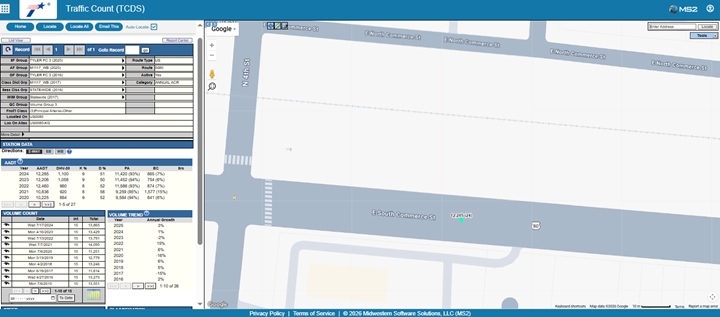
Sources of AADT and Link Volumes
Before estimating turning movements, traffic engineers typically obtain baseline volumes from:
1. DOT AADT Databases
Most state and provincial DOTs publish Annual Average Daily Traffic (AADT) data through:
- traffic count maps
- highway monitoring programs
- functional classification reports
These datasets provide link-level traffic volumes but not turning movements.
2. Existing Traffic Impact Studies (TIS/TIA)
Previous studies often include:
- directional link volumes
- peak hour estimates
- assumed traffic distributions
These are commonly reused for adjacent developments.
3. Travel Demand Models
Regional transportation models provide:
- forecast link volumes
- directional splits
- peak hour outputs
These are useful for planning-level estimation.
4. Field Link Counts
In many cases, only midblock or directional counts are available, without intersection turning data.
Why AADT Alone Is Not Enough
AADT and link volumes only describe how much traffic exists, not how it distributes at intersections.
However, intersection analysis requires:
- left-turn movements
- through movements
- right-turn movements
This is why a conversion step is required to estimate TMCs from AADT or link volumes.
How to Estimate TMCs from AADT or Link Volumes
A standard planning-level approach involves four steps:
1. Convert AADT to Peak Hour Volume
AADT is converted to peak hour volume using:
This produces estimated peak hour flows for each approach.
2. Assign Turning Movement Percentages
Each approach is allocated:
- left-turn percentage
- right-turn percentage
- through movement percentage
These are typically based on:
- nearby intersection data
- engineering judgment
- land use and network context
3. Balance Intersection Flows
Estimated turning movements are checked for consistency by comparing:
- upstream approach volumes
- downstream link volumes
- internal turning flows
This helps identify unrealistic distributions or missing traffic sources.
4. Refine Assumptions Iteratively
Turn percentages and directional splits are adjusted until:
- intersection flows are balanced
- results are reasonable for site conditions
- peak hour behavior is consistent
When This Method Should Be Used
AADT-based turning movement estimation is appropriate for:
- conceptual traffic studies
- preliminary intersection analysis
- low-volume rural intersections
- feasibility-stage development planning
- screening-level traffic assessments
It is not a replacement for field-collected TMCs in final design or signal timing studies.
Limitations
Estimated TMCs from AADT are planning-level only and may differ from real-world conditions due to:
- local traffic generators
- driver behavior
- seasonal variation
- peak spreading effects
- network interactions
Results should always be validated where possible.
A Practical Tool for AADT to TMC Conversion
To simplify this process, engineers can use the:
AADT to Turning Movement Estimator by Arterials.co
This tool converts link volumes into estimated turning movement counts using:
- K-factor and PHF adjustments
- Initial Turning Movement Count solution based on the Furness / Fratar Method.
- user-defined turn percentages
- upstream/downstream balancing checks
- visual intersection flow diagrams
How the Estimator Balances Traffic Volumes
The estimator uses the Furness (Fratar) balancing method to generate an initial set of turning movement volumes that are consistent with the available roadway counts.
The Furness method is a widely used iterative balancing technique in transportation planning. Starting with an initial estimate based on user-defined turning percentages, the algorithm repeatedly adjusts the turning movement matrix until the estimated movements are consistent with the known approach and downstream link volumes while preserving the overall traffic distribution as closely as possible.
Once this balanced solution has been established, users can further refine individual turning movements using their engineering judgment. The estimator continuously reports downstream volumes as changes are made, helping maintain a realistic and internally consistent set of traffic movements.
Why Not Just Apply Turn Percentages?
Applying fixed turning percentages independently to each approach often produces turning movements that do not balance with observed roadway volumes. The total traffic entering and leaving an intersection may differ from known link counts, resulting in an inconsistent traffic assignment.
By applying the Furness (Fratar) balancing method, the estimator generates an internally balanced starting solution before any manual adjustments are made. This provides a more reliable foundation for planning-level traffic analysis while still allowing engineers to incorporate site-specific knowledge where appropriate.
Conclusion
When turning movement counts are not available, engineers can still estimate TMCs using AADT or link volumes by:
- converting to peak hour flows
- applying turn distribution assumptions
- balancing intersection movements
This allows traffic studies to proceed even in data-limited conditions while maintaining planning-level accuracy.
For quick estimation, tools like the Arterials AADT to TMC Estimator provide a structured and efficient workflow for early-stage traffic analysis.