This glossary provides a comprehensive reference of commonly used abbreviations in transportation and traffic engineering. It covers terminology relevant to traffic studies, transportation planning, pavement design, and transit operations. Each entry includes a concise definition, with links to detailed guides or tools on Arterials.co, offering a reliable resource for professionals, planners, and students alike.
Transportation Engineering Abbreviations
| Abbreviation | Meaning | Notes / Link |
|---|---|---|
| AADT | Annual Average Daily Traffic | ADT averaged over a year (link) |
| AAS | Average Arrival Speed | Traffic metric |
| AASHTO | American Association of State Highway and Transportation Officials | Guidelines |
| AAWDT | Average Annual Weekday Traffic | Traffic metric |
| AD | Approach Delay | Intersection delay metric |
| ADT | Average Daily Traffic | Total vehicles per day |
| BRT | Bus Rapid Transit | Transit mode (link) |
| C | Cycle Length | Signal timing metric |
| CBR | California Bearing Ratio | Pavement soil strength test |
| D/C | Demand to Capacity Ratio | Congestion metric |
| D/D | Delay per Driver | Intersection measure |
| DH | Design Hour | Hour used for capacity design |
| DHV | Design Hourly Volume | Peak hour traffic for design |
| ES | Emergency Stop Lane | Road design |
| ESAL | Equivalent Single Axle Load | Pavement design (link) |
| ESAL | Equivalent Single Axle Load | Pavement design (link) |
| ESAL/day | ESAL per day | Pavement load metric |
| FFS | Free Flow Speed | Speed under ideal conditions |
| FHWA | Federal Highway Administration | US highway standards |
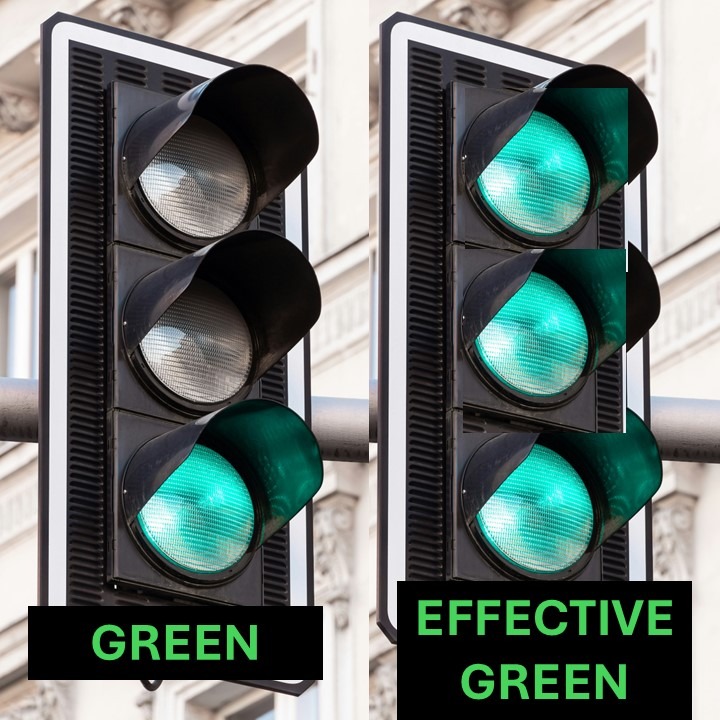
| g | Green Time | Signal timing (link) |
| GIS | Geographic Information System | Mapping / analysis (link) |
| GVW | Gross Vehicle Weight | Vehicle load |
| HCM | Highway Capacity Manual | Standard for capacity analysis |
| HCM | Highway Capacity Manual | Standard |
| HGV | Heavy Goods Vehicle | Truck classification |
| HOV | High Occupancy Vehicle | Carpool lanes |
| IRI | International Roughness Index | Pavement smoothness |
| ITE | Institute of Transportation Engineers | Professional body (link) |
| k | Peak Hour Factor | Fraction of hourly traffic in peak 15-min (link) |
| K factor | Directional factor | (link) |
| LDT | Light Duty Truck | Truck classification |
| LOS | Level of Service | Traffic quality (A–F) |
| LOS A | Level of Service A | Free flow |
| LOS adj | Level of Service Adjusted | Adjusted for conditions |
| LOS B | Level of Service B | Stable flow |
| LOS C | Level of Service C | Stable flow |
| LOS D | Level of Service D | Approaching unstable |
| LOS E | Level of Service E | Unstable flow |
| LOS F | Level of Service F | Jammed |
| LRS | Linear Referencing System | GIS / transportation (link) |
| LRT | Light Rail Transit | Transit mode (link) |
| LRT headway | Light Rail Transit headway | (link) |
| MDT | Mean Daily Traffic | Average vehicles/day |
| MOE | Measure of Effectiveness | Traffic performance metric |
| MUTCD | Manual on Uniform Traffic Control Devices | Signs, markings standards |
| NCHRP | National Cooperative Highway Research Program | US traffic research |
| NMT | Non-Motorized Traffic | Bicycles, pedestrians |
| PC | Passenger Car | Vehicle type |
| PCU | Passenger Car Unit | Standardizes mixed traffic (link) |
| PCU conversion | Passenger Car Unit conversion | Standardization |
| PCU/hr | Passenger Car Units per Hour | Flow metric |
| PH | Peak Hour | Time of maximum traffic |
| PH cap | Peak Hour Capacity | Vehicles/hr/lane |
| PH cap | Peak Hour Capacity | Vehicles/hr/lane |
| PHF | Peak Hour Factor | Factor to convert hourly flow to 15-min peak (link) |
| PHV | Peak Hour Volume | Vehicles in peak hour |
| PM | Project Manual | Construction / traffic document |
| PSI | Pavement Serviceability Index | Pavement quality |
| PT peak | Public Transport Peak | Maximum ridership |
| PuT | Public Transport | Transit mode (link) |
| Q | Flow rate | Vehicles/hr/lane |
| RCI | Road Capacity Index | Congestion measure |
| ROR | Run-Off-Road | Safety metric |
| s | Saturation Flow Rate | Vehicles/lane/hr |
| SADT | Seasonal Average Daily Traffic | ADT averaged for a season |
| SAT | Saturation | Flow metric |
| SOV | Single Occupancy Vehicle | Non-carpool vehicle |
| TDM | Travel Demand Management | Trip reduction strategies (link) |
| TIA | Traffic Impact Assessment | Similar to TIS (link) |
| TIS | Traffic Impact Study | Traffic impact of a project (link) |
| TIS checklist | Traffic Impact Study checklist | (link) |
| TMC | Turning Movement Count | Traffic operations hub |
| TMP | Traffic Management Plan | Construction / event traffic control |
| TMP | Transportation Master Plan | Transportation Master Plan |
| TPD | Trips Per Day | Traffic metric |
| TPD peak | Trips Per Day peak | Peak trips |
| TWLTL | Two-Way Left Turn Lane | Road geometry |
| V/C | Volume to Capacity Ratio | Congestion measure |
| V/C adj | Volume/Capacity adjusted | Flow metric |
| V/C max | Maximum Volume/Capacity Ratio | Congestion measure |
| V/C ratio | Volume to Capacity Ratio | Congestion measure |
| VMT | Vehicle Miles Traveled | Total distance by vehicles |
| VPD | Vehicles Per Day | Flow metric |
| VPH | Vehicles Per Hour | Flow metric |
By using this glossary of traffic engineering abbreviations, professionals and students can quickly understand the terminology commonly encountered in transportation planning, traffic analysis, and roadway design. This reference is intended to support accurate communication, efficient study, and practical application in projects, ensuring clarity across all traffic engineering contexts.
You can also download this glossary and print it for quick reference.