When performing signalized intersection analysis in tools such as Synchro or HCS, two commonly misunderstood parameters are Lane Utilization Factor (LUF) and Saturation Flow Rate (s).
Both directly influence delay, capacity, and level of service calculations under the framework of the Highway Capacity Manual (HCM).
This article provides a clear technical explanation of both terms and how they interact in practical traffic analysis.
You can also check out this quick reference of traffic engineering terms and definitions.
Saturation Flow Rate (s)
Definition: Saturation flow rate is the maximum rate at which vehicles can pass through an intersection approach under prevailing conditions, assuming continuous green and no lost time.
It is typically expressed in: vehicles per hour per lane (veh/h/ln)
Base Saturation Flow Rate
According to the Highway Capacity Manual, the base saturation flow rate (s₀) is: 1900 passenger cars per hour per lane (pc/h/ln)
This assumes:
- Ideal lane width (3.6-3.75 m / 12 ft)
- No heavy vehicles
- Level grade
- No parking friction
- No bus blockage
- Uniform lane utilization
- No turning impedance
Adjusted Saturation Flow Rate
In practice, the actual saturation flow is adjusted:Where:
- f_w = lane width factor
- f_HV = heavy vehicle factor
- f_g = grade factor
- f_p = parking factor
- f_bb = bus blockage factor
- f_a = area type factor
- f_LU = lane utilization factor
Most traffic analysis software performs these adjustments automatically once geometric and traffic inputs are defined.
Lane Utilization Factor (LUF)
What is Lane Utilization?
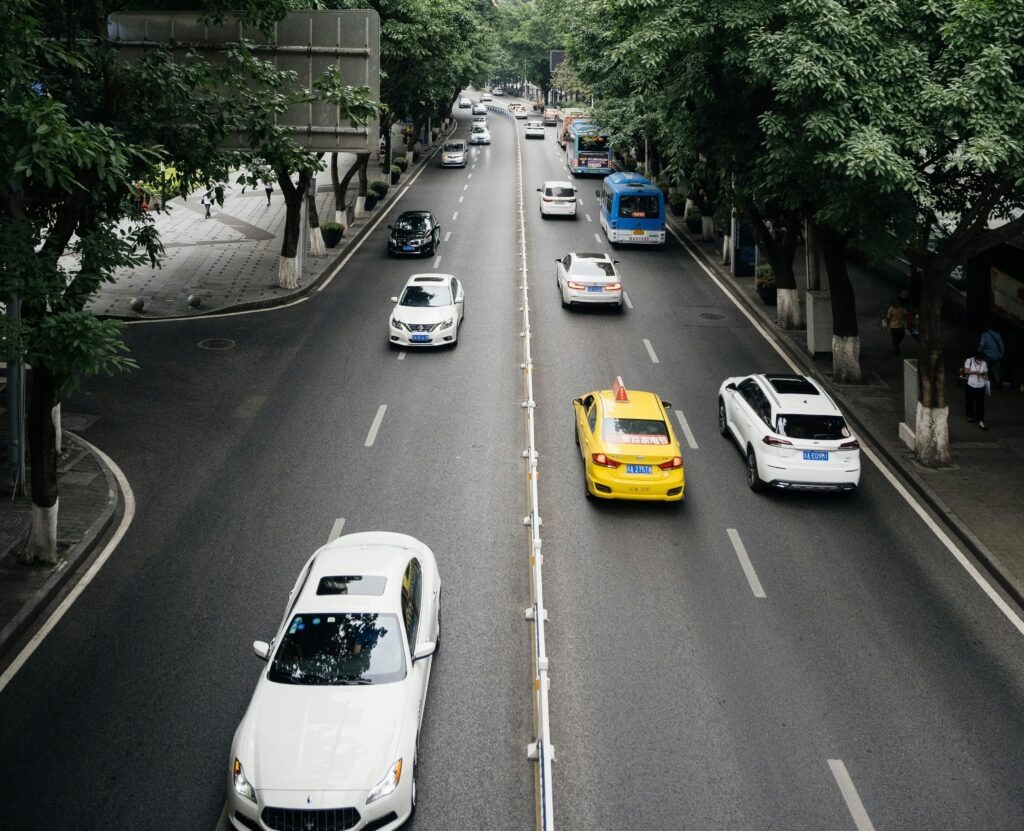
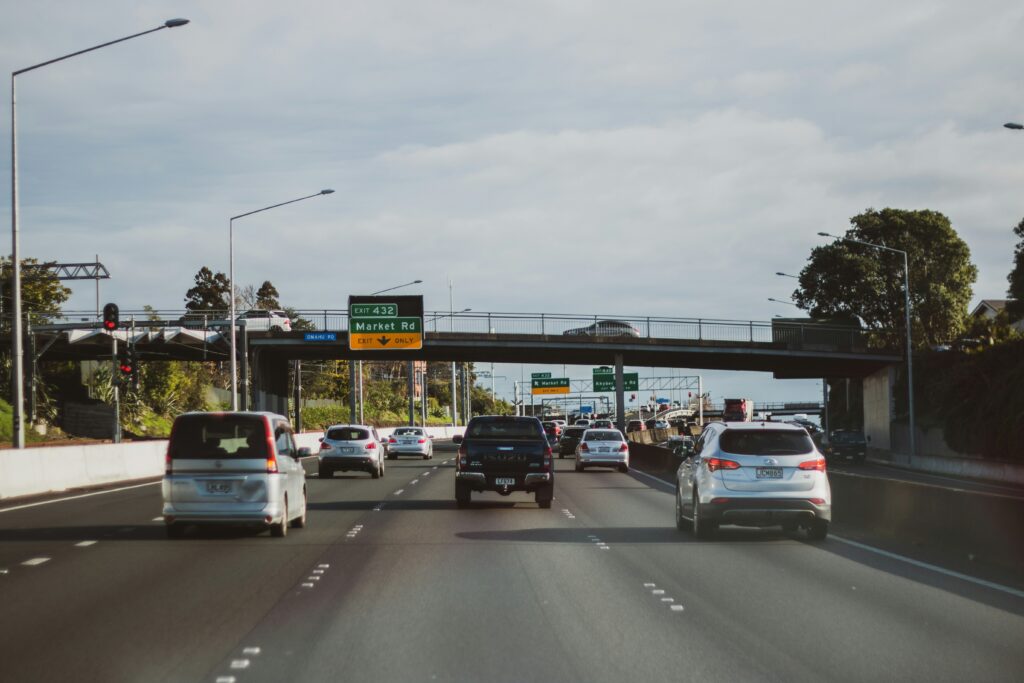
At a multi-lane approach, drivers do not always distribute evenly across available lanes.
Example:
Two through lanes:
- Lane 1 = 900 veh/h
- Lane 2 = 600 veh/h
Even though total flow is 1500 veh/h, one lane carries more demand.
This uneven distribution reduces effective capacity.
Lane Utilization Factor (fLU)
Lane Utilization Factor adjusts capacity to account for unequal lane loading.
If lanes are perfectly balanced: fLU ≈ 1.00
If one lane carries significantly more traffic: fLU < 1.00
In HCM methodology, the critical lane group governs capacity calculations. Synchro automatically identifies the highest v/s ratio lane within a lane group.
Why Lane Utilization Matters in Synchro
In Synchro:
- Capacity is calculated per lane group.
- Delay and LOS are based on critical lane volume.
- Uneven lane loading increases v/c ratio.
- Higher v/c ratio increases delay non-linearly.
If you manually override lane volumes incorrectly, you may:
- Underestimate delay
- Overestimate capacity
- Misreport Level of Service
For accurate modeling:
- Use observed lane-by-lane counts where possible.
- Avoid arbitrarily balancing volumes unless justified.
Relationship Between Saturation Flow and Lane Utilization
Capacity for a lane group is:Where:
- c = capacity
- s = adjusted saturation flow rate
- g = effective green time
- C = cycle length
If lane utilization is uneven:
- Effective s decreases
- Critical lane v/c increases
- Control delay increases
Thus, even small changes in lane distribution can significantly affect LOS results.
Practical Engineering Implications
Lane utilization and saturation flow rate are especially critical in:
- Traffic Impact Assessments (TIA)
- Intersection capacity upgrades
- Signal timing optimization
- Dedicated turn lane evaluations
- Road diet analysis
- Multilane urban arterial corridors
Misunderstanding these factors can lead to incorrect conclusions about whether an additional lane is warranted.
Summary
Saturation flow rate defines theoretical discharge capacity under ideal conditions.
Lane utilization reflects real-world driver behavior.
Together, they determine actual intersection performance.
When using analysis tools like Synchro or HCS, understanding the underlying HCM methodology is essential — rather than relying purely on software outputs.