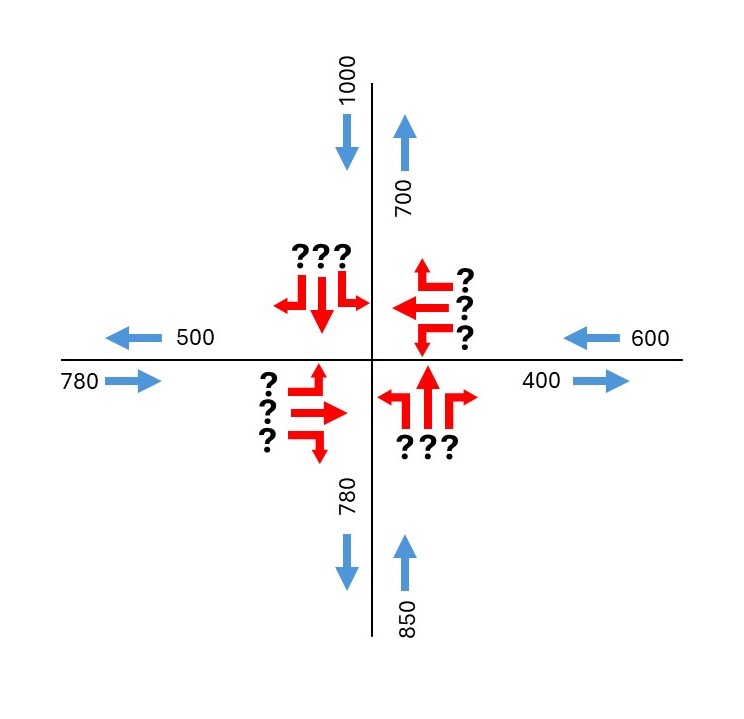
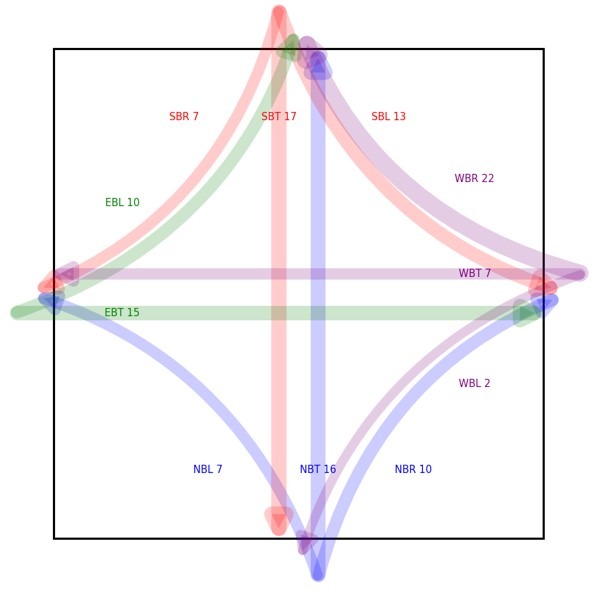
Pedestrian counts are an essential input for intersection analysis (the main element in Traffic Impact Studies), particularly when modeling signalized intersections in software such as Synchro, Sidra, or VISUM. Unlike vehicle counts, pedestrians interact differently with traffic flows, and their impact on vehicle movements is captured through conflicting pedestrian volumes rather than directional “pedestrian flows.”
Concept of Conflicting Pedestrians
A conflicting pedestrian is any pedestrian whose crossing movement delays a vehicle turning or passing through the intersection. For example:
- Vehicles turning right on red or making left turns may be delayed by pedestrians crossing their path.
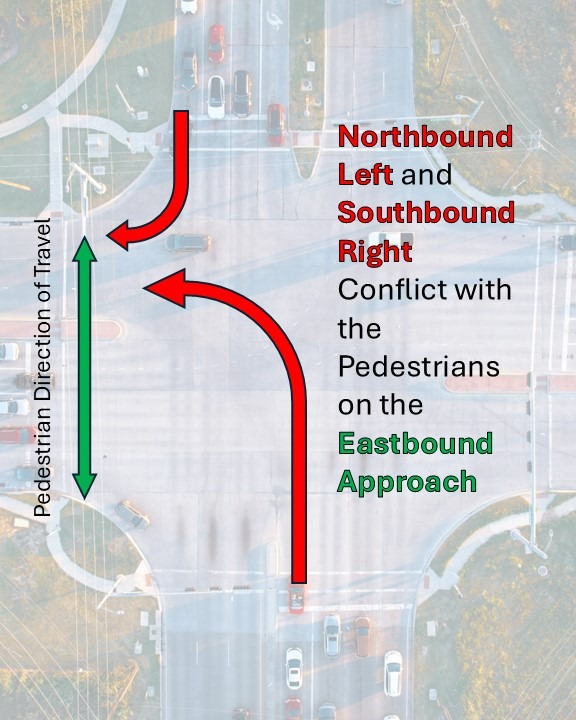
- Pedestrians on the northbound approach do not represent “northbound pedestrians” in terms of vehicle delay. Instead, they conflict with vehicles making eastbound right turns (EBR) or westbound left turns (WBL), because these turning vehicles must yield to pedestrians crossing the northbound leg.
Example 1:
- NB Approach Pedestrians: Conflicting with:
- EBR (Eastbound Right)
- WBL (Westbound Left)
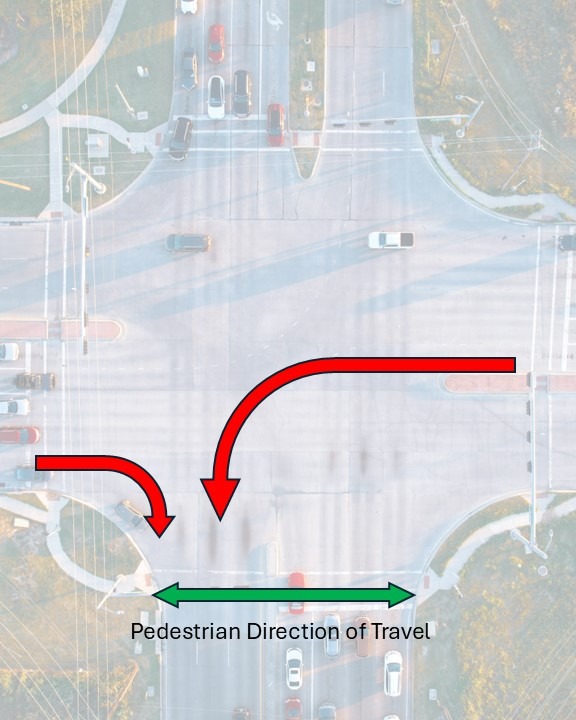
Example 2:
- SB Approach Pedestrians: Conflicting with:
- WBR (Westbound Right)
- EBL (Eastbound Left)
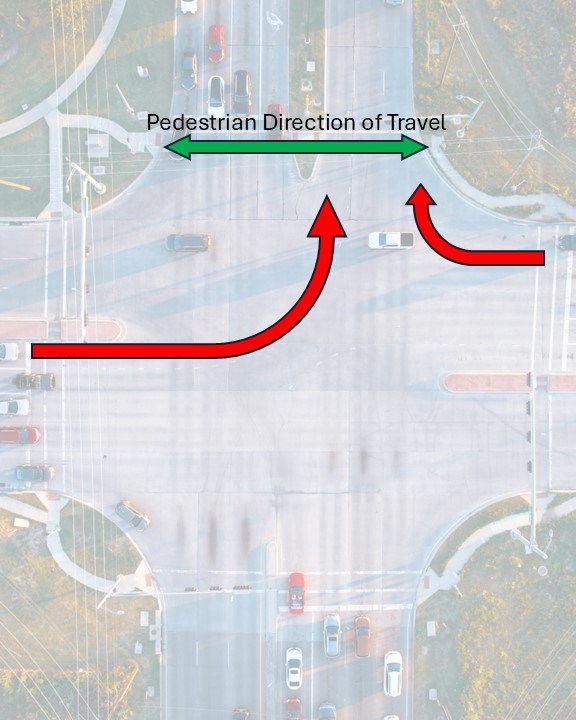
This framework ensures that pedestrian impacts are properly reflected in signal timing calculations, lane capacity analyses, and delay estimates.
Applying Pedestrian Counts in Software
When inputting pedestrian data into Synchro or similar software:
- Count pedestrians crossing each approach (not along the roadway). See Arterials Ai Traffic Counting Software which counts pedestrian movements at each approach in addition to vehicle turning movements.
- Assign these counts as conflicting volumes for the corresponding turning vehicle movements.
- Use 15-minute intervals to align with peak hour factor (PHF) calculations if needed. See detailed how-to for conducting traffic counts.
Notice how in Synchro you can only enter options for Conflicting Pedestrians for the Movements and not the approaches. Also notice how the Through movement does not get any conflicting pedestrians.
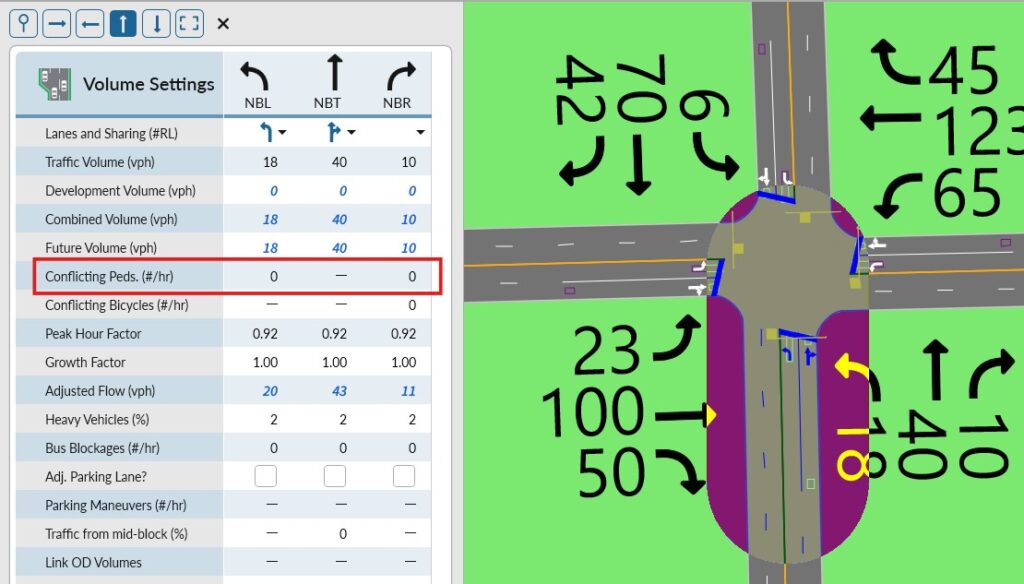
Conflicting Pedestrian Equations
Let’s define the standard assignments for a four-legged intersection:
| Pedestrian Approach | Conflicting Movements |
|---|---|
| NB Peds | Conflicting with EBR, WBL |
| SB Peds | Conflicting with WBR, EBL |
| EB Peds | Conflicting with NBL, SBR |
| WB Peds | Conflicting with NBR, SBL |
Where:
- NBL = Northbound Left
- NBT = Northbound Through
- NBR = Northbound Right
- EBL = Eastbound Left
- etc.
This mapping ensures that vehicles turning across pedestrian crossings are properly delayed in the software model, allowing Synchro or Sidra to calculate realistic queue lengths, delays, and level-of-service (LOS).
Key Notes
- Pedestrian counts are crossing counts, not directional flows along the road.
- Conflicting movements must be carefully assigned; mislabeling leads to under- or overestimation of delays.
- In complex intersections or multi-leg intersections, the same approach can be extended to additional legs using the same logic.
- A diagram showing approach directions, turning movements, and conflicting pedestrians is highly recommended for clarity.