In signalized intersection analysis, few parameters influence results as strongly and as quietly as lost time adjustment. When using Synchro or applying the Highway Capacity Manual (HCM) methodology, adjusting lost time can significantly change:
- Effective green time
- Capacity (c)
- v/c ratio
- Control delay
- Level of Service (LOS)
Because of this sensitivity, lost time adjustments must be applied carefully, transparently, and defensibly.
What is Lost Time?
Lost time in traffic engineering represents the portion of a signal phase that is not effectively used by traffic.
It consists of:
Start-up Lost Time
The delay between the onset of green and when queued vehicles begin discharging at saturation flow. Think of it as the few seconds after green when the first drivers are still reacting and accelerating. Even if one impatient driver creeps forward early, most vehicles don’t immediately discharge at full flow. Its the time wasted/lost between seeing the green light, moving foot to accelerator, shifting and finally rolling.
Clearance Lost Time
Conversely, Clearance Lost Time is the portion of yellow and all-red time that is not effectively used for vehicle discharge. While a few aggressive drivers may gun it through late, most drivers slow or stop, leaving some capacity unused.
Total lost time reduces effective green (g):Where:
- G = displayed green
- l = total lost time
Why Lost Time Matters
Capacity for a lane group is:Where:
- s = saturation flow rate
- g = effective green
- C = cycle length
If you reduce lost time:
- Effective green increases
- Capacity increases
- v/c decreases
- Delay decreases
Small adjustments in lost time can materially change whether:
- v/c is slightly above 1.00
- Or slightly below 1.00
This is where professional judgment becomes critical.
Lost Time Adjustments in Synchro
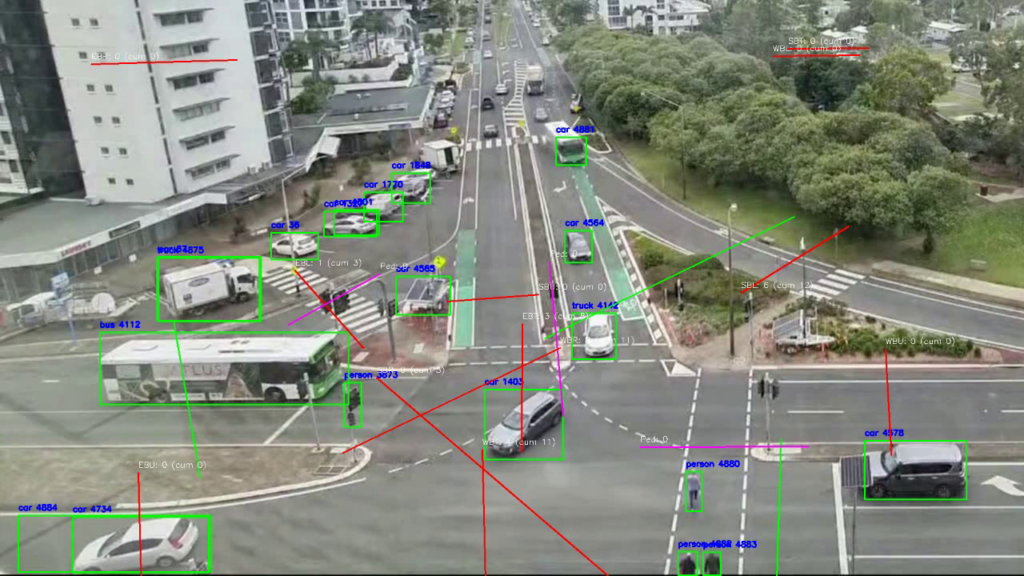
Lost Time Adjustment tweaks the phase lost time to reflect how real drivers actually behave; some jump early on green or push through yellow/red, while others hesitate, adjusting capacity accordingly.
Synchro allows users to:
- Enter phase lost times manually
- Apply adjustment factors
- Modify default start-up and clearance values
Using aggressive negative lost time adjustments (e.g., -3 to -5 seconds per phase) can artificially increase effective green and improve performance metrics.
While technically possible within the software interface, such adjustments require strong justification.
Appropriate Ranges and Engineering Judgment
Under typical urban conditions, total lost time per phase is generally in the range of:
- 3 to 5 seconds per phase
This includes start-up and clearance components.
Large deviations from standard values should be supported by:
- Field observation
- High-resolution signal controller data
- Documented signal timing plans
- Justifiable operational conditions
Lost time should reflect measured driver behavior and signal design, not modeling convenience.
Practical Lost Time Adjustment Guide (Seconds)
| Adjustment (s) | Driver Behavior / Field Interpretation |
|---|---|
| +2 | Drivers are more cautious – hesitant at green, slower queue discharge, some stop early at yellow; effective green slightly shorter. |
| +1 | Slightly cautious – a small fraction of drivers react slowly; minor reduction in effective green. |
| 0 | Default HCM/Synchro assumption – typical, average driver behavior; standard start-up + clearance lost time. |
| -1 | Slightly aggressive – a few drivers creep forward at green early, minor reduction in start-up lost time. |
| -2 | Moderately aggressive – several drivers anticipate green, discharge slightly faster; minor use of yellow/all-red. |
| -3 | Highly alert / aggressive – most drivers start promptly, some use late yellow; effective green noticeably longer. |
| -4 | Very aggressive – drivers launch quickly at green, most make full use of yellow/all-red; queue clears faster than HCM default. |
| -5 | Extremely aggressive – near-ideal reaction, almost continuous discharge; must be supported by field data. |
Notes for Calibration:
- Negative adjustments increase effective green, reducing v/c ratio and delay.
- Positive adjustments decrease effective green, increasing delay slightly.
- Anything beyond ±2–3 seconds should be justified with field observation or signal controller data.
- Lost time adjustment affects total lost time, combining start-up and clearance implicitly; it is not split in Synchro.
Professional and Ethical Considerations
In Traffic Impact Assessments (TIA) or Intersection Capacity Analyses (ICA), model inputs must be:
- Transparent
- Defensible
- Consistent with agency standards
Artificially inflating capacity by reducing lost time without evidence may:
- Misrepresent intersection performance
- Undermine credibility during review
- Lead to incorrect design decisions
Peer reviewers and agency engineers often examine:
- Cycle length
- Phase splits
- Lost time assumptions
- Saturation flow values
Significant deviations tend to draw scrutiny.
Best Practice Recommendations
When modeling in Synchro:
✔ Use default HCM-based lost time values unless field data suggests otherwise
✔ Document any deviation clearly in the report
✔ Provide reasoning for non-standard assumptions
✔ Avoid adjusting lost time solely to achieve v/c < 1.00
✔ Confirm consistency with local signal timing policies
If adjustments are made, include a short justification note. Transparency builds defensibility.
Summary
Lost time is not just a minor signal parameter, it directly controls effective green and capacity. Large negative lost time adjustments imply near-zero start-up and clearance inefficiencies. Such assumptions require strong field justification, as they materially increase effective green time and intersection capacity.
Because of its influence, it must be treated as a field-based operational variable, not a calibration knob.
Careful, transparent modeling protects:
- Engineering integrity
- Consultant credibility
- Project defensibility
And ultimately, better decisions are made when inputs reflect real-world conditions rather than desired outcomes.