
Traffic counts are the foundation of any Traffic Impact Assessment (TIS/TIA) and even Transportation Master Plans. Accurate traffic data ensures that intersection analyses, turning movements, and operational recommendations are reliable and defensible. This guide provides professional best practices for conducting traffic counts, including count duration, vehicle classification, intervals, intersection coordination, and the use of AI counting tools.
Read: Traffic Impact Study Guidelines
Why Accurate Traffic Counts Are Critical
Accurate traffic counts are essential for:
- Identification of the AM, PM, Mid-day Peak Hours
- Determining peak hour volumes
- Calculation of Peak Hour Factor (PHF)
- Quanitifing Turning movements forecasts for intersections
- Level-of-service analyses and signal timing
- Traffic control planning and roadway design
Errors in counts can propagate through the entire TIS and lead to over- or under-design, inefficient signal timings, or costly revisions.
Count Duration: 12, 16, and 24 Hours
Count duration should reflect the operational needs of the site:
- 12-hour counts (typically 7 AM–7 PM) capture standard peak periods.
- 16-hour counts (6 AM–10 PM) capture early morning and late evening variations.
- 24-hour counts are sometimes required for sites with significant night-time traffic or when jurisdictional standards demand them.
Note: Some jurisdictions restrict truck movements during nighttime hours (e.g., trucks may not be permitted to enter before 11 PM or midnight), which should be considered when planning counts.
Vehicle Classification
For most TIS purposes:
- Focus on heavy vehicles (trucks) and buses only when they significantly impact intersection operations.
- Buses are not automatically considered heavies unless their operational characteristics (acceleration, turning radius) affect capacity analyses.
- In regions with high motorcycle or scooter volumes (e.g., Pakistan, India, Indonesia, Nigeria, Phillipines, Vietnam, Thailand), classification may be necessary. Applying Passenger Car Unit (PCU) factors prevents overestimating lane demand or intersection capacity.
Count Intervals
- 15-minute intervals are standard for PHF calculations in TIS.
- These intervals allow accurate identification of the peak hour, and calculation of peak hour volumes and turning movement peaks.
Coordinating Counts Across Multiple Intersections
Counts for intersections that are part of the same network should be conducted simultaneously.
Reasons include:
- Volume balancing: Ensures consistent total flows across intersections.
- Driveways between intersections: Traffic entering/exiting mid-block can affect counts if intersections are counted on different days.
Failure to synchronize leads, to discrepancies and misrepresent traffic patterns. Asynchronous counts may get rejected by the reviewing agency.
Roundabouts and Complex Intersections
Counting roundabouts and complex intersections poses additional challenges:
- Traffic may circulate in ways that are not directly observable from a single approach.
- Simultaneous equations or manual balancing methods are become required for estimate turning movements.
- For roundabouts, both approach entering volumes and exiting traffic volumes need to be counted at each leg. Then you can set up equations to solve for the Turning movements.
Recommendation: Use Arterials AI traffic counting software, which automates this process, accurately counts circulating flows, and reduces manual effort and potential errors.
How long are Traffic Counts valid for
- Counts are typically valid for 3–6 months, depending on expected growth, seasonality, and local developments.
- Counts in rapidly developing areas or near construction zones should be updated more frequently.
Counts can also be used to estimate Annual Average Daily Traffic (AADT) using seasonal and day-of-week adjustment factors.
Traffic Count Formats
Proper formatting ensures data can be efficiently used in traffic engineering software (Synchro, Sidra, Arcady, VISUM, etc.):
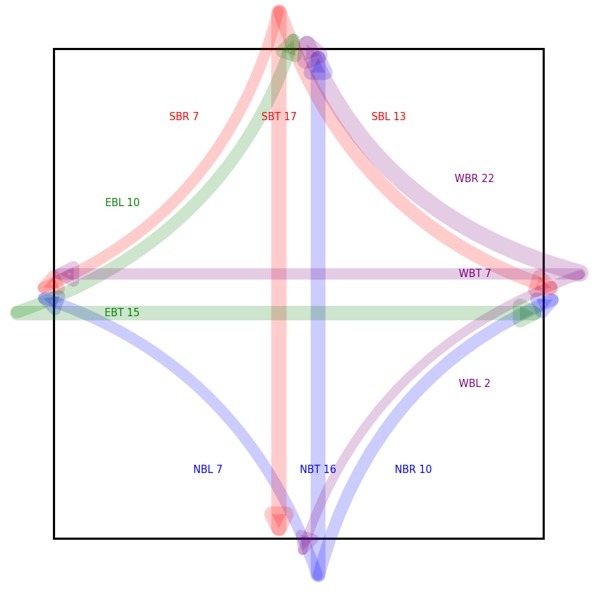
- Turning Movement Counts (TMCs): Record all movements per approach (Left, Through, Right).
- Two-way counts: Record flows in both directions for segments between intersections.
- Direction definition: Use approach-based terminology. For example:
- Northbound approach = traffic traveling toward the intersection in the north direction / Coming FROM the south.
- NBL, NBT, NBR = Northbound Left, Through, Right
- Turning movement diagrams: Include clear tables or diagrams to allow engineers to directly input into software. Typically, diagrams show the AM and PM Volumes, and the collected counts for the entire duration. Data is also to be provided in Tabular Format.
Consistency and clarity prevent confusion during analysis and ensure counts can be reused or audited.
Pedestrian and Cyclist Counts
In addition to vehicles, accurate pedestrian and cyclist counts are essential for comprehensive Traffic Impact Studies.
- Cyclists: Count cyclists moving in the same direction as motorized traffic on each approach. This ensures proper integration with lane usage, turning movements, and capacity analyses.
- Pedestrians: Count pedestrians crossing the street across the approach. For example, Northbound Pedestrians refers to the volume of pedestrians crossing the northbound approach leg. Pedestrian counts are typically oriented perpendicular to traffic flow, usually in the east-west direction relative to the intersection.
These counts help identify potential conflicts between pedestrians, cyclists, and vehicles and can inform signal timing, crosswalk design, and traffic control plans.
Manual, Video, and AI-Based Counting
- Manual or video-based counts: Useful for small sites or highly complex intersections; allows for verification and adjustment of classifications.
- AI-based counting:
- Rapid, scalable deployment across multiple intersections
- Automated vehicle classification and turning movement capture
- High accuracy with minimal manual effort
Arterials AI traffic counting software is particularly effective for multi-intersection studies, complex intersections, and roundabouts, ensuring accurate, repeatable counts with minimal human intervention.
Key Takeaways
- Accurate traffic counts are essential for reliable TIS analyses and design recommendations.
- Use appropriate count durations (12, 16, or 24 hours) and intervals (15 minutes) based on site needs.
- Focus classification on heavy vehicles and motorcycles where PCU adjustments are required. For pavement design, see ESAL.
- Synchronize counts across intersections to account for volume balancing and intermediate driveways.
- Use standardized terminology and diagrams to facilitate software input.
- Consider AI-based counting solutions for efficiency, accuracy, and scalability.
By following these professional best practices, traffic engineers can ensure that their TIS analyses are defensible, accurate, and consistent across projects.


