Traffic signals are at the heart of modern intersections. Their timing not only dictates how efficiently traffic flows but also affects safety, pedestrian accessibility, and overall network performance. To design or evaluate a signal plan, engineers rely on a set of technical terms that describe how green, yellow, and red indications are distributed across phases and cycles.
This article breaks down the essential signal timing plan terms—including green time, yellow time, all-red time, offsets, recall, and more—and explains how they relate to each other. It also covers the different types of signal control used around the world, from fixed-time signals to actuated-coordinated systems.
Do you even need a signal? Try our traffic signal warrant calculator.
Signal Cycle and Cycle Length
- Cycle: One complete sequence of signal indications at an intersection (e.g., North-South green → yellow → red, then East-West green → yellow → red).
- Cycle Length: The total time (in seconds) to complete one full cycle.
- Example: If N-S green lasts 30s, N-S yellow 4s, all-red 2s, E-W green 25s, E-W yellow 4s, and all-red 2s → cycle length = 67s.
Signal Phase
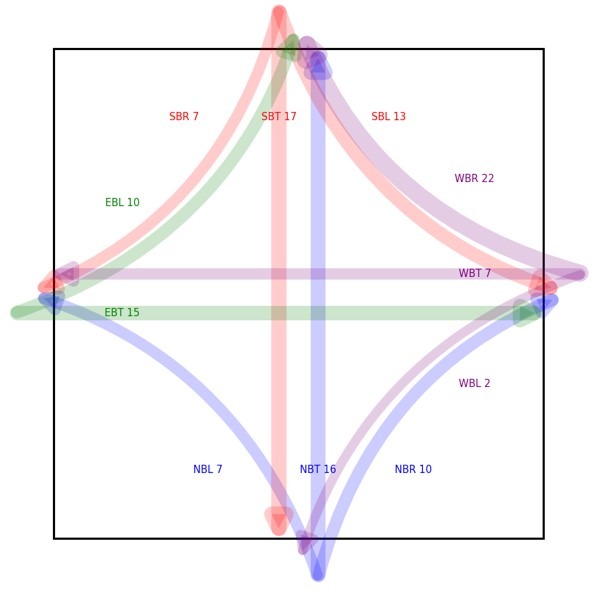
- A phase corresponds to a distinct movement (or set of compatible movements) receiving the right-of-way.
- Example: One phase may serve northbound left-turns, while another serves east–west through traffic.
- Most modern controllers have 8 phases available, though not all are always used.
Green Time
- Portion of the cycle when a phase is given the green indication.
- Determines how many vehicles can pass during that phase.
- Must be balanced across phases to optimize flow.
Yellow (Amber) Time
- The transition period (typically 3–5 seconds) between green and red.
- Allows drivers in the “dilemma zone” to clear the intersection safely.
- Poor yellow timing can cause abrupt stops or red-light running.
All-Red Time
- Period after yellow where all directions show red.
- Provides clearance for vehicles still in the intersection.
- Usually 1–3 seconds, depending on intersection size and approach speeds.
Pedestrian Timing Elements
- Walk Time: Period when the pedestrian signal displays “WALK.”
- Flash Don’t Walk (FDW): Blinking interval giving pedestrians time to finish crossing.
- Pedestrian Clearance Time: Based on crossing distance ÷ assumed walking speed (often 1.2 m/s).
- Must align with vehicle timings for safety.
Recall in Traffic Signals
- Recall ensures a phase always appears in the cycle, even if no demand is detected.
- Minimum recall: Phase gets minimum green every cycle.
- Maximum recall: Phase gets maximum green.
- Useful for pedestrians, transit priority, or phases with consistent demand.
Lead and Lag
- Lead: A turning movement (usually left-turn) starts before the opposing through movement.
- Lag: The turn occurs after the through movement.
- Lead-lag phasing: A combination used to improve arterial progression.
Offset
- In coordinated systems, offset is the time difference between the start of green at one intersection and the start of green at the next downstream intersection.
- Proper offsets create “green waves,” minimizing stops.
Signal Splits
- The percentage of cycle length allocated to each phase.
- Example: In a 90s cycle, if Phase 2 gets 40s and Phase 6 gets 50s → split = 44% / 56%.
Lost Time in Traffic Signals
- Time not effectively used for vehicle movement.
- Includes startup lost time, yellow and all-red intervals, and unused green.
Effective Green Time
- Actual usable green after accounting for lost time.
- Critical for calculating capacity using HCM methods.
Signal Coordination vs. Free Operation
- Coordinated Operation: Signals along a corridor share a cycle length and offsets to support progression.
- Free Operation: Each intersection runs independently, responding only to local demand.
Actuated Control Elements
- Detectors: Sensors detect vehicles or pedestrians.
- Gap-Out: Green ends early when no new vehicles arrive.
- Max-Out: Green ends when maximum programmed green is reached.
- Force-Off: Green is terminated to maintain coordination.
Types of Signal Control
1. Fixed-Time (Pre-Timed) Signals
- How it works: Each phase has fixed times, regardless of demand.
- Best for: CBDs or predictable traffic.
- Pros: Simple, predictable, easy to coordinate.
- Cons: Inefficient when demand is variable.
2. Actuated Signals
- How it works: Demand-driven via detectors.
- Best for: Variable suburban intersections.
- Pros: Efficient, adaptive.
- Cons: Costlier, harder to coordinate.
3. Semi-Actuated Signals
- How it works: Major street fixed, minor street actuated.
- Best for: Arterials with occasional side-street traffic.
- Pros: Efficient balance, avoids stopping main road unnecessarily.
- Cons: Longer waits for minor approaches.
4. Actuated-Coordinated Signals
- How it works: Actuated locally but synced to corridor cycle and offsets.
- Best for: Busy arterials needing both flexibility and progression.
- Pros: Combines efficiency with coordination.
- Cons: Complex to implement and maintain.
Quick Comparison Table
| Control Type | How it Works | Best Use Case | Pros | Cons |
|---|---|---|---|---|
| Fixed-Time (Pre-Timed) | Set times regardless of demand | Stable traffic (CBDs) | Simple, predictable, easy to coordinate | Wastes green when demand is low |
| Actuated | Detectors trigger green | Variable/suburban traffic | Adaptive, efficient | Higher cost, harder to coordinate |
| Semi-Actuated | Main road fixed, side streets actuated | Arterials w/ light side streets | Balances efficiency | Minor street delays |
| Actuated-Coordinated | Actuated locally, synced to corridor | Arterials needing progression | Efficient + coordinated | Complex setup |
Relationships Between Terms
- Cycle length = sum of all green, yellow, and all-red times.
- Splits = allocation of cycle time per phase.
- Offset = determines coordination between intersections.
- Lost time reduces usable green, lowering capacity.
- Pedestrian timings often set the minimum green for vehicles.
Signal timing is a careful balancing act between safety, efficiency, and coordination. By understanding elements like green, yellow, all-red, recall, offsets, phases, cycle length, and the types of control strategies, traffic engineers can design plans that keep traffic flowing while ensuring pedestrian and cyclist safety.